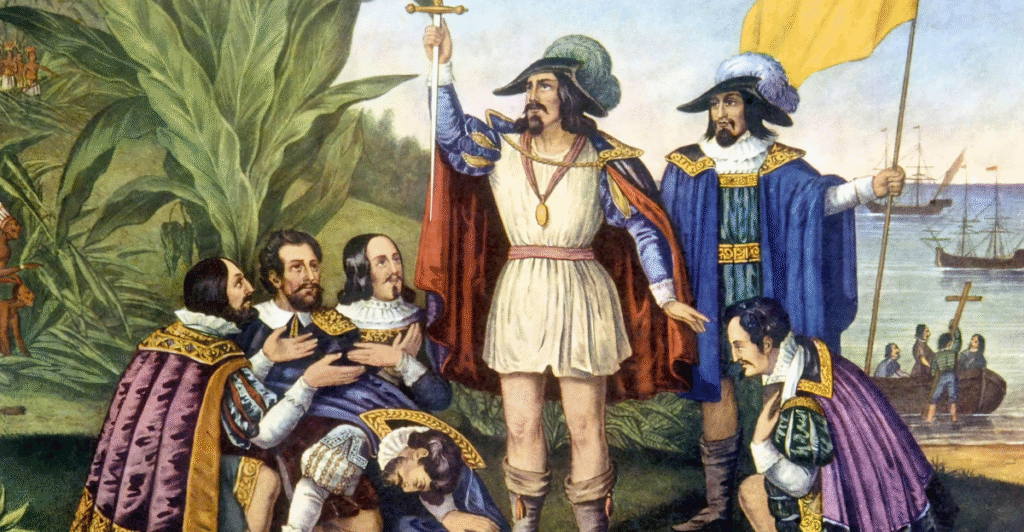
Christopher Columbus is known for “discovering” America in 1492. But that’s not the full story. Columbus wasn’t who we think he was. School textbooks paint him as a hero. But he was not, contrary to popular belief, the first European in the Americas. Here are some unexpected facts about Columbus you probably didn’t hear of in school.
He Never Set Foot on the U.S. Mainland

Despite what you thought, Columbus never actually reached the mainland of what is now the United States of America. His four journeys took him to parts of the Caribbean and Central and South America. The closest he came was Puerto Rico, today a U.S. territory, where he landed on his second voyage in 1493.
Vikings Beat Him by 500 Years

Leif Erikson was a Norse explorer who arrived in North America approximately in the year 1000, a long time before Columbus. The Vikings even temporarily had small settlement in what is now Canada.
He Thought He Was in Asia

Columbus thought he had found islands near China or India. This is why he called indigenous people “Indians” – an error that stuck. Even after numerous voyages, he was convinced that he had found a new course to Asia and not a whole new continent. Columbus was not a good navigator. He underestimated the size of Earth’s and didn’t even know the Pacific Ocean existed. His miscalculations could have ruined him, but luckily, the Americas were on his path.
Spain Almost Didn’t Fund Him

Columbus first proposed his idea to Portugal, but they denied him. King Ferdinand of Spain and Queen Isabella also said no. But after years of asking, they eventually gave in; especially because they wanted to compete with Portugal.
The Ships Weren’t What You Think

You may have heard of the Niña, the Pinta, and the Santa María. But the Niña was actually a nickname; the ship’s official name was the Santa Clara. The Santa María, his biggest ship, sank on the first voyage. Columbus then had to leave men behind. He was arrested and taken back to Spain in chains after his third voyage. Even the Spanish crown believed his rule over the colonies was too cruel. Christopher Columbus was later freed but lost his titles and much of his wealth.
He Didn’t Prove the Earth Was Round

People say that Columbus proved the Earth was round and not flat. But educated Europeans already knew it was round by the 15th century. What he did accidentally prove, however, was that there were more continents than people thought.
His Journeys Led to Devastation

Columbus marked the start of European colonization, leading to forced labor, disease and violence towards indigenous people. His men’s actions would lead to centuries of suffering for native people.
He Died Poor and Bitter

Columbus spent his remaining years trying to recover his lost wealth and status. He died in 1506, still thinking he had found parts of Asia. He wasn’t aware that he’d unveiled an entirely new world. Some see Columbus as a brave explorer; others think of him as a brutal colonizer. Recently, many regions have substituted Columbus Day with Indigenous Peoples’ Day to commemorate the darker side of his history.
He Still Changed History Forever

Columbus wasn’t the first nor the best, but his travels changed history. There’s no denying the mark he made, whether you see him as a hero or as a villain. As you can now see, Columbus’ true story is much more complicated than what you were taught at school.
2026 Update: The DNA Claim About Columbus’s Origins, and Two More Details
The newest debate about Columbus is about where he came from. On October 12, 2024, Spain’s public broadcaster RTVE aired the documentary Colón ADN, su verdadero origen. It presented work by forensic scientist José Antonio Lorente of the University of Granada. Using DNA from Columbus’s son Hernando and a relative, the team argued that the bones in Seville Cathedral really are the explorer’s. The Dominican Republic also claims to hold his remains. The documentary went further and suggested Columbus was a Sephardic Jew from the Valencia region rather than a Genoese Christian. Other geneticists quickly objected that none of the data had been peer-reviewed or published. Lorente replied that the film was not a scientific paper and promised a formal publication. Until that evidence can be checked, most historians still accept Genoa as his birthplace.
Columbus never reached the U.S. mainland, but on his second voyage in November 1493 he landed on Puerto Rico, which is a U.S. territory today. And the Niña sailed under a nickname; its official name was Santa Clara. The Santa María was the ship’s proper name. Sailors’ slang for it was La Gallega.
Sources
- NPR: Christopher Columbus may have been a Spanish Jew, according to a new documentary
- Britannica: Christopher Columbus