On June 4, 1944, America pulled off something they had never managed to do, capture an intact Type IXC submarine, the U-505. It was a great accomplishment for the U.S. Military, and the capture was led by Captain Daniel Gallery.
The Capture Operation

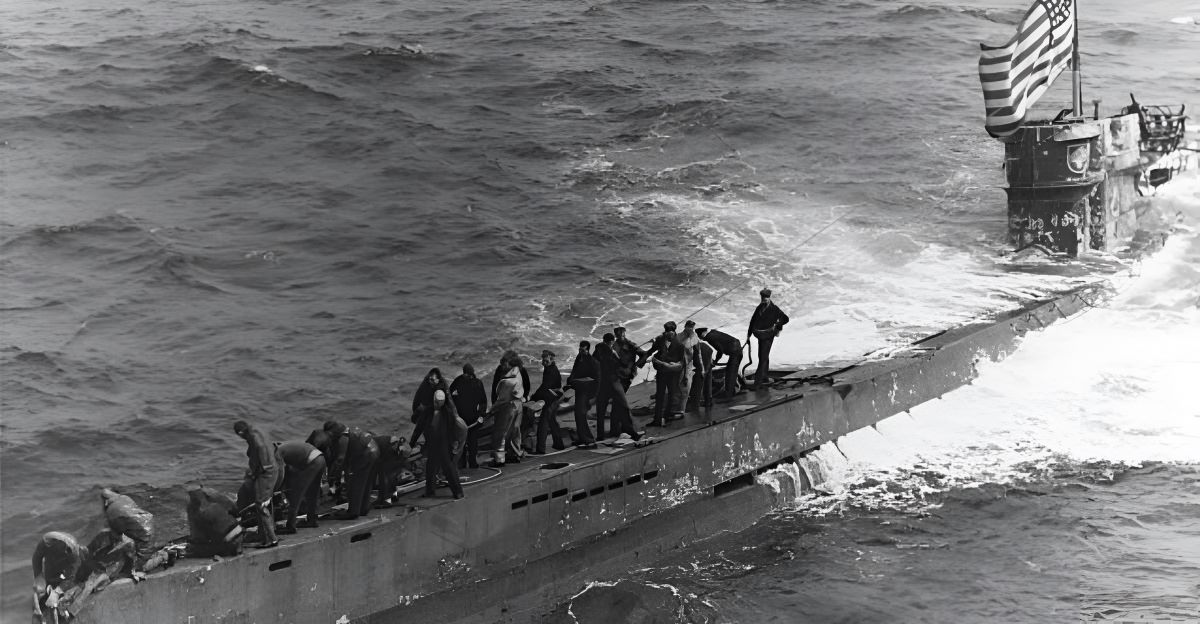
Task Group 22.3 of the U.S. Navy gathered around the USS Guadalcanal on June 4, 1944, where they engaged with the German U-boat U-505. The engagement started just off the coast of Africa, where sonar and depth charges were used to force the U-boat to come to the surface. As normal procedure, the German soldiers tried to scuttle their U-boat, preventing it from capture, but for some reason, they failed.
The Boarding Party

Once the ship was on the surface, A Lieutenant Junior Grade named Albert L. David was among the first to board the vessel. The submarine was damaged and posed many hazards for the boarding party, yet they wanted to see if they could find any sensitive information that could be of use. They managed to find relevant documents and two Enigma machines.
Importance of Intelligence

The U.S. Navy managed not only to save the documents inside but also to keep the whole submarine from sinking and capture it, a feat that hadn’t been done before. With the whole submarine captured, the military gained access to important communications equipment that helped decrypt German naval communications.
Aftermath of the Capture

The U.S. Navy towed the U-505 to Bermuda where it could be repaired. After the repairs were finished, the U-boat toured with the military to several cities on the East Coast to raise morale as part of a war bond drive. This helped raise money for the war that was still going on in the Pacific against Japan. The captured submarine was a symbol of the U.S. Navy’s power.
Preservation Efforts

Once World War II was over, the Navy planned to use the U-505 for target practice. Captain Gallery’s brother spoke out against this idea. The submarine was subsequently moved to Chicago’s Museum of Science and Industry, now the Griffin Museum of Science and Industry, where it was restored and can still be found today.
Historical Significance

The U-505 is completely restored and in a museum; it is an exceptionally rare and unique artifact from World War II. Its history showcases the strength of the U.S. Navy when capturing enemy intelligence was a crucial turning point in the war.
Current Exhibit

The U-505 submarine is still displayed at the Griffin Museum of Science and Industry in Chicago. There, people can not only view the vessel but even walk inside it. The submarine is now a National Historic Landmark and is protected as such. It is a crucial piece of WWII history.
Legacy of U-505

The capture of the vessel not only shows us a bit more about how naval combat was conducted in World War II but also the ingenuity of the American Navy. Their determination to claim victory at all costs shows just how important intelligence can be.
An Iconic Piece Of History

U-505 remains an iconic piece of history that offers insight into WWII naval battles and intelligence operations. Its journey from capture to preservation illustrates not only military achievement but also cultural significance as an educational resource for future generations.
2026 Update: The Secret Prisoners of U-505
One part of the U-505 story rarely makes it into museum summaries: keeping the capture secret was nearly as important as the boarding itself. Research by the National WWII Museum in New Orleans shows that the 58 surviving German crewmen were not handled like ordinary prisoners of war. They were sent to Camp Ruston in Louisiana and held in an isolated section of the camp. Their names were withheld from the International Red Cross and they were not allowed to write home. Allied leaders wanted Berlin to believe the boat had gone down with all hands. If Germany had known otherwise, it would have changed its codes, and the Enigma machine and code books seized from U-505 would have lost much of their value.
The deception held. The U.S. Navy did not release the full story of the capture until May 1945, after Germany’s surrender. Meanwhile, the captured material helped Allied planners steer convoys away from U-boat patrol areas. In 1953, Captain Daniel Gallery persuaded the Navy to give the submarine to Chicago’s museum rather than scrap it. If you plan a visit, note the new name: it is now the Kenneth C. Griffin Museum of Science and Industry. U-505 has been on display there since 1954. It is a National Historic Landmark, and the exhibit now includes nearly 200 artifacts and an optional tour inside the boat.
Sources
- The National WWII Museum: Louisiana, U-505 and Camp Ruston
- Griffin Museum of Science and Industry: U-505 Submarine